Steinway grand and upright pianos are found across concert halls, teaching studios and private homes. Age, factory, model and restoration history all influence how an individual instrument feels and sounds.
This guide introduces the principal ranges and the practical questions to ask before buying or restoring one.

Guide
Steinway grand pianos
Compare the principal grand models, their sizes and the rooms and players they tend to suit.
Guide
Steinway upright pianos
Understand the character, condition and restoration considerations of older Steinway uprights.
Workshop
Steinway restoration
See how structural, action, tonal and cabinet work can be planned around the piano and its intended use.
Hamburg and New York Steinways
Steinway has manufactured pianos in both Hamburg and New York. Instruments found in the UK are commonly Hamburg-built, particularly among twentieth-century examples.
Visual details can help with identification: many New York grands have a more squared fallboard profile, while Hamburg examples commonly use a rounded profile. Tonal descriptions such as “mellow” or “brilliant” can be useful starting points, but they are not reliable rules. Hammer choice, voicing, regulation, room acoustics and restoration history can create substantial differences between two pianos from the same factory.
The most useful comparison is therefore between the individual instruments, not only the badge or factory.
Condition and restoration
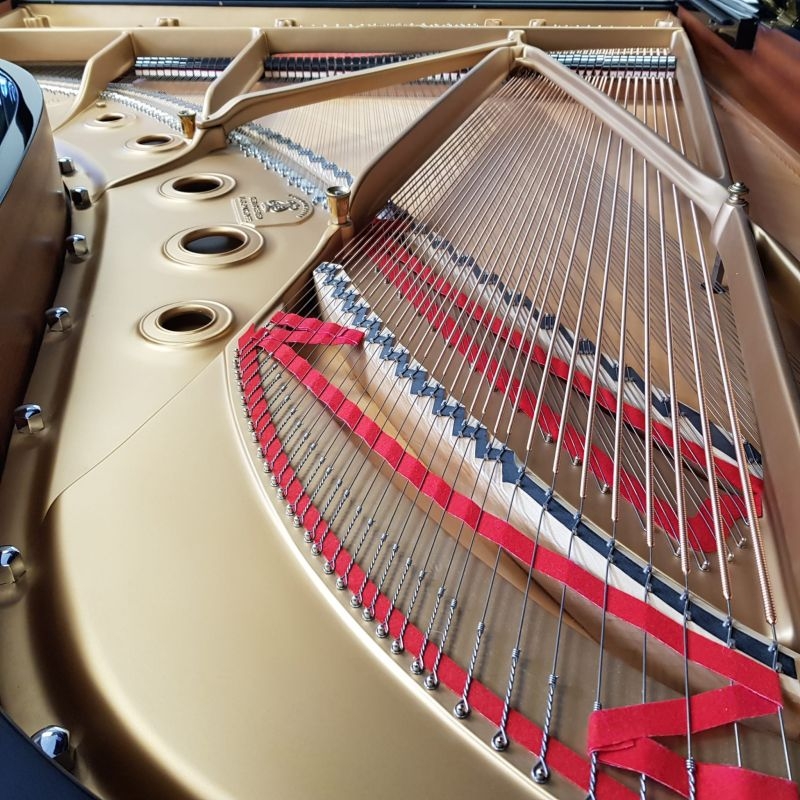
On an older Steinway, the name alone does not establish condition or value. A careful assessment should consider the wrest-plank and tuning stability, soundboard and bridges, strings and frame, action wear, hammers, dampers, pedals and cabinet.
Regularly played instruments may need action regulation as cloth, felt, leather and springs settle or wear. Others may need new hammers, restringing or more extensive structural work. Traditional finishes can often be conserved or restored, while later polyester finishes require different methods.
A restoration plan should be based on the piano’s present condition, musical potential, intended use and budget. Ask who completed previous work and request a written explanation of what is original, repaired or replaced.
Steinway Model M
At approximately 170cm (5ft 7in), the Model M is a medium-sized grand intended to combine a manageable footprint with the response and tonal range of a grand piano.
Examples in the UK span different periods and conditions. As with every older Steinway, preparation and restoration history matter as much as age. Listen across the full compass, test repetition and dynamic control, and compare the instrument in a suitable acoustic.
Frequently asked questions
Is my Steinway worth restoring?
Many Steinway grands justify careful restoration, but the answer depends on model, condition, musical potential, provenance, proposed work and likely use. Uprights vary particularly widely. Obtain an independent assessment and current written estimate before deciding.
How should I care for a Steinway?
Keep temperature and humidity reasonably stable, arrange regular tuning and avoid placing the piano beside strong heat or direct sunlight. Use methods appropriate to the cabinet finish and ask a technician before cleaning action parts, strings or dampers.
Considering a Steinway?
Browse current pianos or ask the Oxford team about a particular model, restoration or suitability.