A well-prepared Steinway upright can offer a firm, responsive touch and a broad tonal range in a more compact footprint than a grand piano.
Older examples vary considerably. Model, age, factory, construction and restoration history should all be considered alongside the way the individual piano plays.
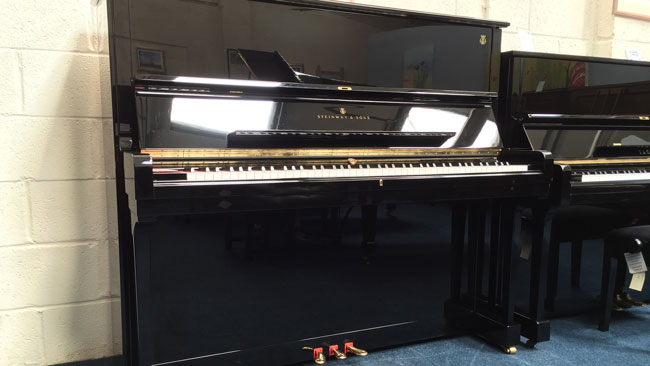
Models commonly found in the UK
Dimensions can vary slightly by period and factory. Measure the individual piano before planning access or room placement.
Full-size upright
Model K
Approximately 132cm high
Approximately 152.5cm wide
Approximately 68cm deep
One of the most frequently encountered Steinway uprights. Earlier examples are often rosewood or ebonised; mahogany became more common during the twentieth century, while later instruments are frequently black polyester.
Upright
Model V
Approximately 125cm high
Approximately 152.5cm wide
Approximately 67.5cm deep
A substantial domestic upright with a smaller case than the Model K. Condition, action preparation and tonal work determine how successfully an older example performs.
Less common
Models N, E and Z
Other Steinway upright models appear less frequently and span different scales and periods.
Do not identify a piano from cabinet height alone. Serial number, frame markings, compass and construction details provide stronger evidence.
Older 85-note instruments
Some pre-1900 Steinway uprights have 85 notes, ending at top A rather than the modern 88-note compass ending at top C. Those three highest notes are used relatively rarely, but the reduced compass should still be considered by advanced players and anyone choosing an instrument for a specific repertoire.
An 85-note compass is not itself evidence that a piano is unsuitable. Structural stability, action condition, tone, tuning stability and the quality of previous work are more important to the musical result.
What to inspect before buying
Structure and tuning
Check tuning-pin stability, wrest-plank condition, bridges, soundboard, strings and frame. Ask whether structural work has been completed and by whom.
Action and tone
Assess hammer wear, centres, springs, key bushings, repetition, regulation and voicing. A prestigious name does not compensate for an action that needs extensive work.
Cabinet and environment
Identify the finish before cleaning or polishing. Look for signs of prolonged dryness, damp or direct heat and consider whether the piano has been prepared for its intended room.
Smaller twentieth-century uprights
Compact Steinway uprights from the mid-twentieth century vary in scale design, condition and musical result. Compare the individual piano with other high-quality compact uprights rather than choosing by name alone.
For any used upright, play quietly and loudly across the keyboard, test repetition and sustain, listen for abrupt tonal changes, and obtain a technician’s assessment before committing to significant restoration.
Need help identifying one?
Send the serial number, full front photograph, frame markings and approximate dimensions. We can advise on the likely model and appropriate next step.
Considering a Steinway upright?
Browse current pianos, return to the Steinway overview, or ask the Oxford team about condition and restoration.