Blüthner piano guide
How to distinguish under-damper and over-damper Blüthner uprights, what each design means for the player, and which technical checks matter before purchase.
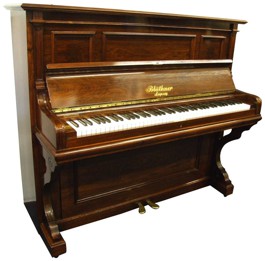
Overview
Two damping systems, two very different experiences
Blüthner uprights can offer the mellow tonal character and smooth action associated with the maker’s grand pianos. In the UK, however, many surviving nineteenth- and early-twentieth-century examples use an over-damper action. The damper design has a direct effect on how cleanly notes stop sounding.
Under-damper examples are less common and are generally the more practical starting point for a player, but the individual piano still needs to be judged on tone, action condition, tuning stability and previous restoration.

An under-damper Blüthner upright mechanism
Usually the stronger player’s choice
Under-damper Blüthner uprights
Straight-strung and overstrung under-damper examples are most often encountered from about 1910 onwards. The taller instruments can have a rich tone and a particularly satisfying action when properly restored and regulated.
Cabinets are commonly rosewood or black. Many are overstrung, although straight-strung examples should not be dismissed: design, scale and present condition matter more than a simple construction label.
Common in earlier instruments
Over-damper Blüthner uprights
Over-damper uprights are especially common among Blüthner instruments dating from roughly 1880–1915. In this design the dampers operate above the hammers. They tend to stop the strings less efficiently, particularly in the upper register, so the sound can continue or “ring on” after the key is released.
Some players enjoy the character of a well-prepared historic piano, but over-damper actions are rarely the best choice when clean damping, precise repetition and straightforward servicing are priorities.
At a glance
Under-damper versus over-damper
| Point to compare | Under-damper | Over-damper |
|---|---|---|
| Note cut-off | Generally cleaner and more efficient | Often slower, especially in the treble |
| UK availability | Less common among older Blüthner uprights | Common in pre-1920 examples |
| Buying approach | Still inspect tone, action and structure | Only proceed after careful playing and technical inspection |
Model-by-model judgement
Take care with overstrung under-damper examples
We have encountered noticeable tonal inconsistency in some overstrung under-damper Blüthner uprights, including boomy or uneven areas in the middle and upper registers. Straight-strung examples can be more consistent, but no construction type guarantees a good individual piano.
Blüthner instruments were generally well made and many restore very successfully. The sensible approach is to have the actual piano inspected by an experienced technician before agreeing a purchase or restoration budget.
Ask the technician to check
- Tuning-pin and pin-block security
- Soundboard and bridge condition
- Action wear and regulation
- Damper effectiveness throughout
- Evenness of tone between registers
- Previous restoration quality
Considering a Blüthner upright?
Browse our current instruments or send photographs of the cabinet, action, serial number and interior for an initial view. For a private purchase, arrange an independent inspection before committing.